Most «coffee shop feasibility study» files give you a list of equipment and say «profits are guaranteed,» without answering the two questions that determine the fate of the cafe: How much does one cup cost you in halalas? And how many cups do you have to sell every day so that you don't lose money?
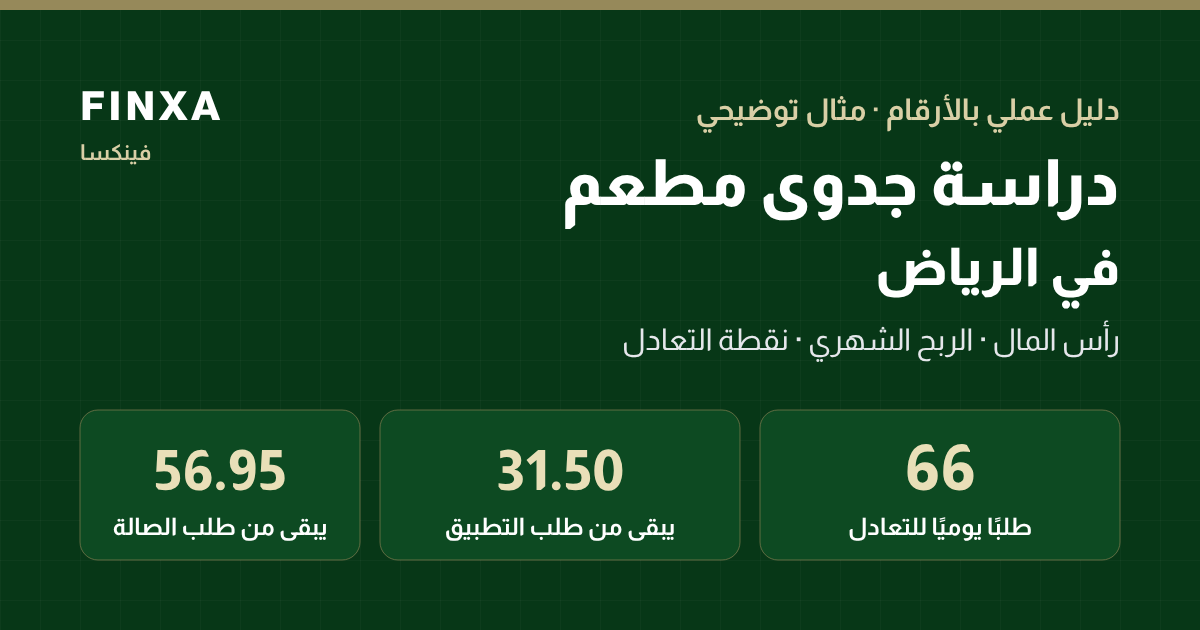
In this guide we build Coffee shop feasibility study Complete for a small specialty coffee shop in Riyadh (illustrative example): pre-opening capital, cost per cup of coffee, milk and cup, monthly expenses, profit, break-even point in the number of cups per day, and how rent changes it.
The numbers are hypothetical for illustration purposes; the idea is that you take the same approach and include your supplier's prices and your site's rent.
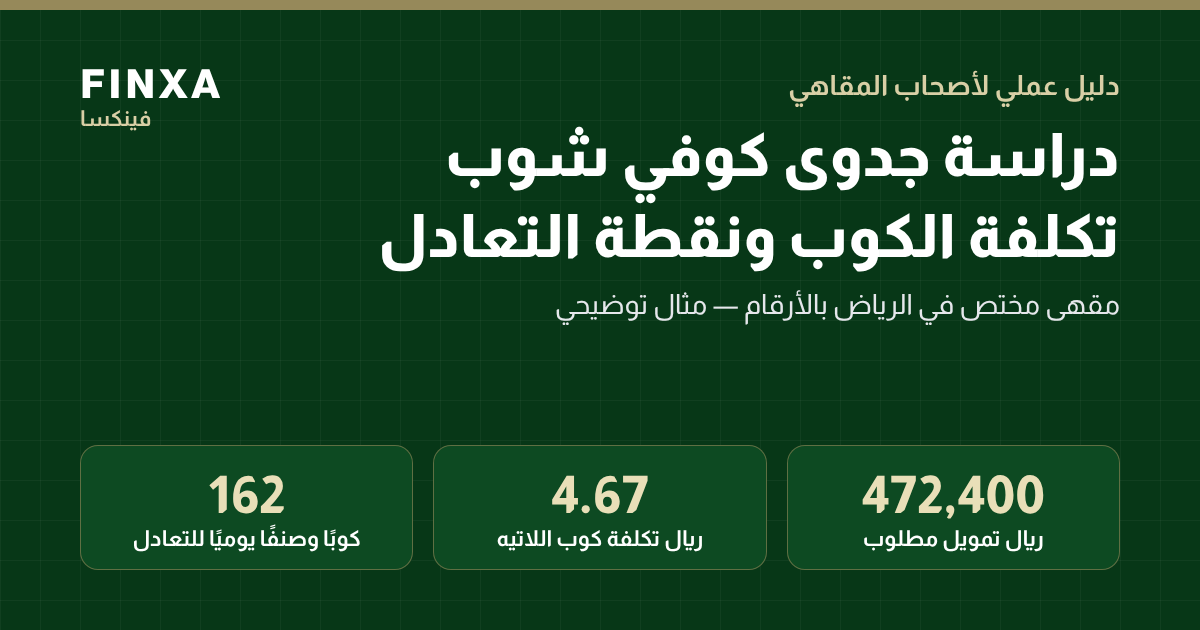
- A small specialty cafe in Riyadh needs approximately 472,000 riyals Before the first cup, of which 134,000 were operational reserves.
- A latte costs 18 riyals. 4.67 riyals Materials and packaging, and you will be left with approximately 11 riyals after tax.
- Break-even point in the example 162 cups and items dailyIt rises to 195 if the rent is 20,000 instead of 10.
All the figures above are illustrative examples.
Step 1: Capital for a coffee shop project (illustrative example)
Let's assume a niche café with an approximate area of 60 square meters in a residential and commercial district in Riyadh, offering small seating areas, takeout, and delivery apps. The figures will vary considerably depending on the location, finishing level, and type of equipment.
| Item | Amount (Riyals) |
|---|---|
| Finishing and decoration | 90,000 |
| Espresso machine, grinder, and bar tools | 75,000 |
| Refrigeration and appliances (refrigerators, freezers, blenders, mini ovens) | 30,000 |
| Furniture | 25,000 |
| Cashier system and devices | 6,000 |
| Registration, licenses, and government fees | 10,000 |
| Rent in advance for 6 months (10,000 per month) | 60,000 |
| Opening stock (coffee, milk, cups, sweets) | 12,000 |
| Recruitment, visas, and residency permits | 20,000 |
| Opening Marketing | 10,000 |
| Total equipment | 338,000 |
| Operating reserve for 3 months of fixed expenses (44,800 x 3) | 134,400 |
| Total funding required | 472,400 |

The machinery and grinder are the largest equipment costs, but the reserve fund is the single largest item in the entire budget. A new café needs months to build a loyal customer base, and the first three months often don't even reach the projected sales figures.
Step 2: The cost of a cup in halalas (the part you won't find in ready-made studies)
This is where the café makes a profit or a loss. Calculate each menu item the same way: ingredients in grams and milliliters, then waste, then the cost per cup and lid, then deduct tax from the menu price. Assumptions (illustrative example): Espresso beans 120 riyals per kilo, specialty drip coffee 160 riyals per kilo, milk 6.5 riyals per liter, and 5% waste of ingredients (grinder adjustment experiments, excess milk, spilled cups).
| Item (menu price including tax) | the components | Waste 5% | Cup and packaging | Cost | Price excluding tax | It's yours | Cost ratio |
|---|---|---|---|---|---|---|---|
| Hot Latte, 18 Riyals (18g coffee + 220ml milk) | 3.59 | 0.18 | 0.90 | 4.67 | 15.65 | 10.98 | 29.8% |
| Iced Spanish Latte, 22 Riyals (18g coffee beans + 200ml milk + condensed milk + ice) | 4.81 | 0.24 | 1.10 | 6.15 | 19.13 | 12.98 | 32.1% |
| V60 Drip Coffee, 20 Riyals (Specialty Coffee Beans 18g) | 2.88 | 0.14 | 0.90 | 3.92 | 17.39 | 13.47 | 22.5% |
| Ready-made cookies from a supplier, 12 riyals | 4.50 | 0.23 | 0.20 | 4.93 | 10.43 | 5.50 | 47.3% |
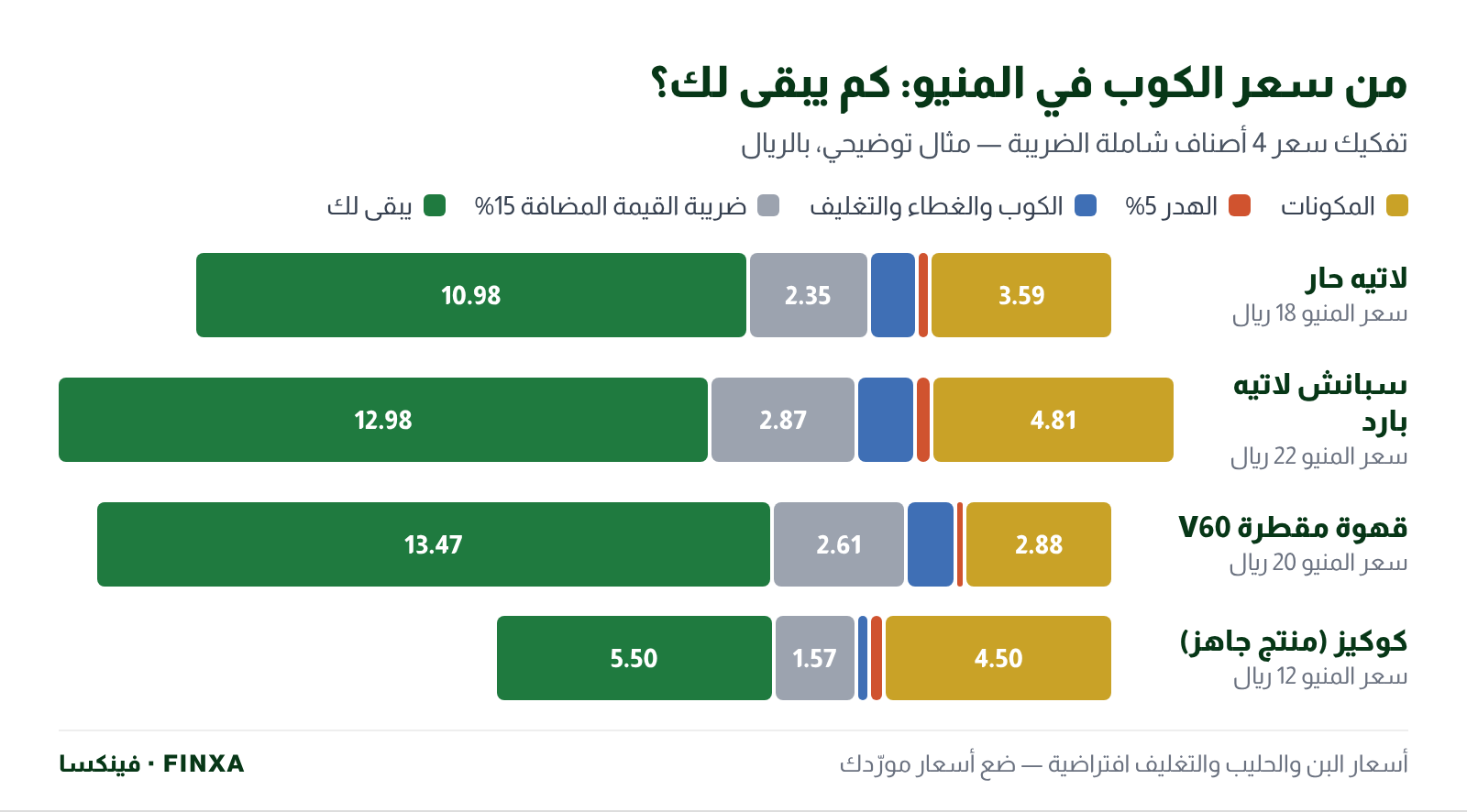
Note two things: Drip coffee is the most profitable item, even though the coffee beans are more expensive, because it's made without milk. Store-bought cookies sell a lot, but they leave you with half the profit of a cup of coffee. If half your sales are store-bought sweets, your break-even point will rise significantly.
With a hypothetical sales distribution (35% Latte, 30% Spanish, 15% Distilled, 20% Desserts), the average price per item excluding tax is SAR 15.91, and its average cost is SAR 5.05. Cost ratio 31.8%. The detailed cost breakdown that most of us forget about in the dish and cup guide can be found there. The actual cost of the dish.
Cup from the counter vs. cup from the app
At the counter, you pay the Mada and card fees (assuming 1%), leaving you with the average price of the item. 10.70 riyals. And from the delivery application with a default commission of 22%, you retain 7.36 riyals That's all. The actual commission rate varies depending on your contract with each app, and we explained how to verify the net amount that reaches the bank in [the previous section]. Delivery app matching.
Step 3: Monthly Fixed Expenses
This applies whether you sell 50 cups or 500 (illustrative example):
| Item | Monthly (Riyal) |
|---|---|
| Rent | 10,000 |
| Salaries and allowances (4 baristas and a supervisor) | 22,000 |
| Insurance, medical insurance, and residency fees (distributed monthly) | 3,000 |
| Electricity, water, and internet | 3,500 |
| Cashier and software subscriptions | 800 |
| Marketing and Social Media | 3,000 |
| Machine and filter maintenance | 1,000 |
| Accounting and bookkeeping | 1,500 |
| Total fixed cash expenses | 44,800 |
| Depreciation of equipment, furnishings and appliances (226,000 over 5 years) | 3,767 |
| Total including depreciation | 48,567 |
note: Insurance contributions vary depending on the employee's nationality and system, so calculate them for each employee from General Organization for Social Insurance website Instead of the estimated figure.
Step 4: Coffee shop monthly profits
Let's assume 230 cups and items per day, 80% from the counter and 20% from apps, over 30 days (illustrative example):
| Item | Monthly (Riyal) |
|---|---|
| Sales excluding tax (6,900 items x 15.91) | 109,786 |
| Cost of materials, waste, and packaging | −34,869 |
| App commissions (1,380 categories) | −4,831 |
| Mada fees and cards | −878 |
| What remains after variable costs | 69,208 |
| Fixed expenses with depreciation | −48,567 |
| Net monthly profit before zakat | 20,641 |
This means that from sales of approximately 110,000 riyals per month, the profit remains at around 21,000 riyals (approximately 19%). A café's margin is usually higher than a restaurant's because the cost per cup is lower than the cost per dish, but the number of transactions is much higher, and any small slippage at the cash register is repeated hundreds of times a day. Therefore... Daily cashier closure More important in the cafe than elsewhere.
Payback period = 338,000 ÷ 20,641 = Approximately 16 months After reaching level 230 items per day, add the starting months.
Step 5: Break-even point in the number of cups per day
The figure of 10.03 represents the average amount of items remaining after mixing counter (80%) and appetizers (20%). This daily figure is what you give to the cafe manager: any day with fewer than 162 items is a losing day.
How does rent change the break-even point?
Rent is the biggest decision you make before opening, and the same cafe with the same menu can change its fate depending on the location (illustrative example, with the same 230 items daily):
| Monthly rent | Break-even point (category/day) | net monthly profit |
|---|---|---|
| 7,000 | 152 | 23,641 |
| 10,000 (example) | 162 | 20,641 |
| 15,000 | 178 | 15,641 |
| 20,000 | 195 | 10,641 |

Every 5,000 riyal increase in rent requires approximately 17 additional cups per day. Before you sign up for a «premium» location with a high rent, ask yourself: Does the location actually bring in 30 or 40 more customers every day?
Sensitivity analysis: If sales dropped 20% to 184 items daily with a rent of 10,000, the profit would remain around 6,800 riyals per month. However, with a rent of 20,000 and the same decrease, the cafe would fall below the break-even point (184 less than 195). The high rent leaves no margin for error.
Tax and electronic invoicing in a cafe feasibility study
- VAT registration: According to the registration page Zakat, Tax and Customs AuthorityRegistration is mandatory for businesses with annual revenues exceeding 375,000 riyals, and optional for those with revenues between 187,500 and 375,000 riyals. The example café sells approximately 1.3 million riyals annually, exceeding the mandatory threshold in the first four months.
- Menu price includes tax: A cup on the menu costs 18 riyals, and your revenue from it is 15.65 riyals, with the remaining 2.35 riyals going to tax. If you calculate your profits based on 18, you inflate your revenue by 15% from the very first line.
- Electronic invoicing: The authority implemented Electronic invoicing («invoice»)» In two phases, the first from December 4, 2021, and the second (connection) from January 1, 2023, on frequencies announced by the authority. Choose a compatible cashier from the start, and continue. Wave 25 Guide.
Once operations begin, periodic reporting requires accurate sales and purchases; you can use [the following]VAT return preparation service.
Common mistakes in coffee shop feasibility studies
- Pricing the cup based solely on the competitor: Without counting grams and milliliters, you don't know if 18 riyals will be a profit for you or not.
- Forgetting the waste: Adjusting the grinder every morning, and excess milk and spilled cups increase the cost per cup by 5% or more.
- Revenue is calculated at the menu price inclusive of tax.
- Treat the application request like a counter request: The commission eats up a third of what's left of the item.
- Heavy reliance on ready-made sweets: Sales increase, but the cost ratio rises.
- Choosing the location before calculating the break-even point: The rent determines how many cups you need, not the other way around.
Frequently Asked Questions
How much does a coffee shop project cost in Riyadh?
There's no single number. A small kiosk might start at tens of thousands, while a cafe with seating and high-end finishes could exceed one million riyals. In our example, we needed 338,000 for setup and 472,000 with operating reserves (illustrative example).
How much profit does the coffee shop make per month?
It depends on the number of daily cups sold, the rent, and the menu layout. For example: 230 items daily with a rent of 10,000 riyals yields approximately 20,600 riyals per month before zakat, while with 162 items, the profit is zero.
What is a reasonable cost percentage for a cup?
In the example, it ranged from 22% for drip coffee to 32% for milk-based drinks, and 47% for ready-made desserts. The important thing is to calculate it for each item in an actual recipe, and to review it whenever the price of coffee or milk changes.
Can I use a ready-made coffee shop feasibility study in PDF format?
As a structure and list of items, yes, but with your own figures: your location rent, your supplier's prices, your team's salaries, and the projected app rate. Using someone else's cafe's ready-made figures gives you misplaced confidence.
How do I find the break-even point for my standing cafe?
Collect your fixed expenses from your books, calculate what remains of the average item after materials, commissions, and fees, then divide the first by the second and by 30. If you don't know the actual cost per cup or the net cost of each application, then this is the first thing that needs adjusting.
When should I register for VAT?
Registration becomes mandatory when your annual revenue exceeds 375,000 riyals, but you can register optionally above 187,500 riyals. Most cafes quickly exceed this threshold, so prepare your cashier and invoices accordingly from the start.
And if you're planning a restaurant instead of a cafe, the same method applies completely. Restaurant feasibility study with figures.
Let's calculate your cafe's real numbers
At Phoenixa, we remotely monitor the accounts of restaurants and cafes, and deliver to you every month the profit of each branch separately, the net profit of each delivery application, the cost per cup, and the actual break-even point instead of the estimated one.
- Free check of one month's books within 48 hoursWe will hand over to you every team we encounter.
- The first month of accounting is free, with no contract and no obligation. After that you choose: continue with us or stop and your notebooks are in order.
Contact us via the WhatsApp button on the website, or start here: