an idea Coffee kiosk It seems easier and cheaper than opening a coffee shop: a small space, two employees, and an espresso machine. But many kiosks close in the first year, often not due to a lack of customers, but because the owner counted sales and forgot to calculate how much profit was left over from each cup after rent, salaries, and taxes.
In this guide, we calculate the cost of a coffee kiosk in Riyadh from scratch in riyals: the cost per cup, fixed expenses, andHow many cups do you need to sell per day? To cover your costs, with a comparison between a fixed kiosk and a mobile coffee cart, and the official licensing methods for each.
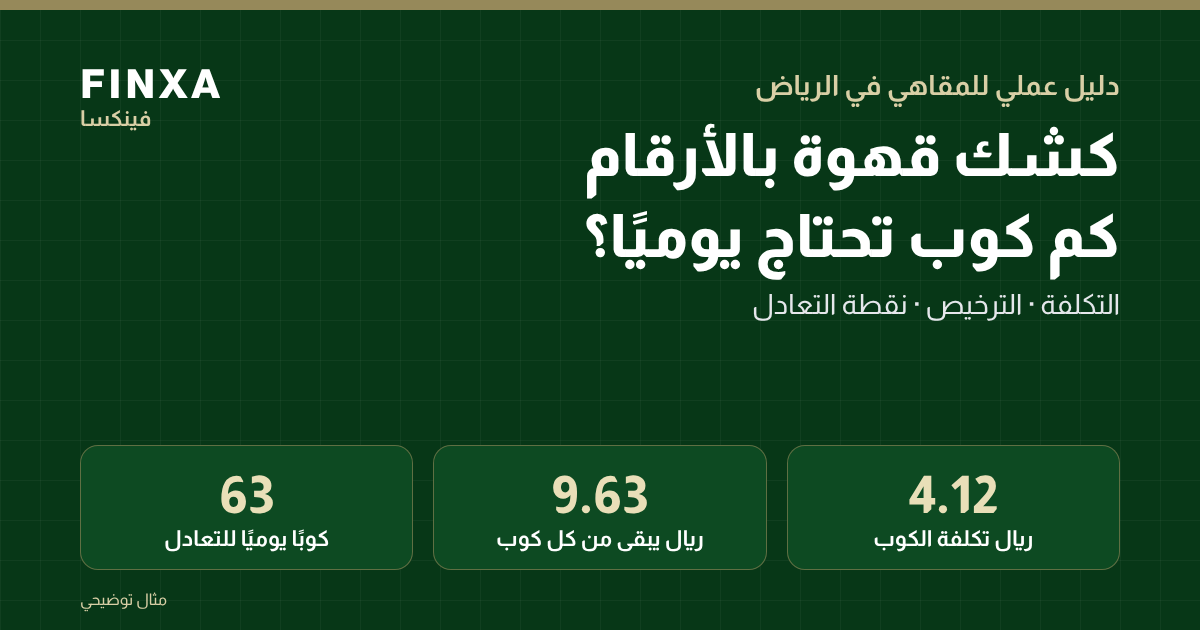
- In our example, a latte costs 16 riyals, and you get some leftovers. 9.63 riyals After tax, ingredients, cup, and card fees.
- A kiosk with fixed expenses of 18,000 riyals per month needs 63 cups a day Just to cover its costs, the coffee cart, with expenses of 8,000 riyals, needs 34 cups.
- The break-even point for the kiosk is very close to the mandatory VAT registration threshold (approximately 65 cups per day), so plan from day one as if you are registered.
All the figures above are for illustrative purposes only and are not market prices or the results of a real project.
Is it a fixed kiosk, a coffee cart, or a small cafe?
Before the numbers, specify the type of project, because each type has a different license and completely different fixed costs:
| Comparison | Fixed coffee kiosk | Mobile coffee cart | small cafe |
|---|---|---|---|
| The place | Mall, promenade, station, municipal land | Reserved site or events | Commercial space with seating |
| Licensing | Business license for the site (according to the owner and the municipality) | Mobile vehicle license from my country | Commercial registration and shop license |
| Largest fixed expense | Rent | Employee and Operations | Rent and salaries |
| Monthly fixed expenses (illustrative example) | 18,000 riyals | 8,000 riyals | Much higher |
| Break-even point (illustrative example) | 63 cups a day | 34 cups a day | We explained it in Coffee shop feasibility study |
A kiosk succeeds through location and foot traffic; it sells many cups quickly without seating. A food cart is cheaper in fixed costs, but its sales fluctuate with location, weather, and events. A café sells an experience and a seating area, and its fixed costs are much higher.
Coffee kiosk licensing: official procedures
The detailed requirements are set by the secretariat and the site owner and are constantly updated, so always rely on the official platform when applying. However, the process varies depending on the type of project you have.
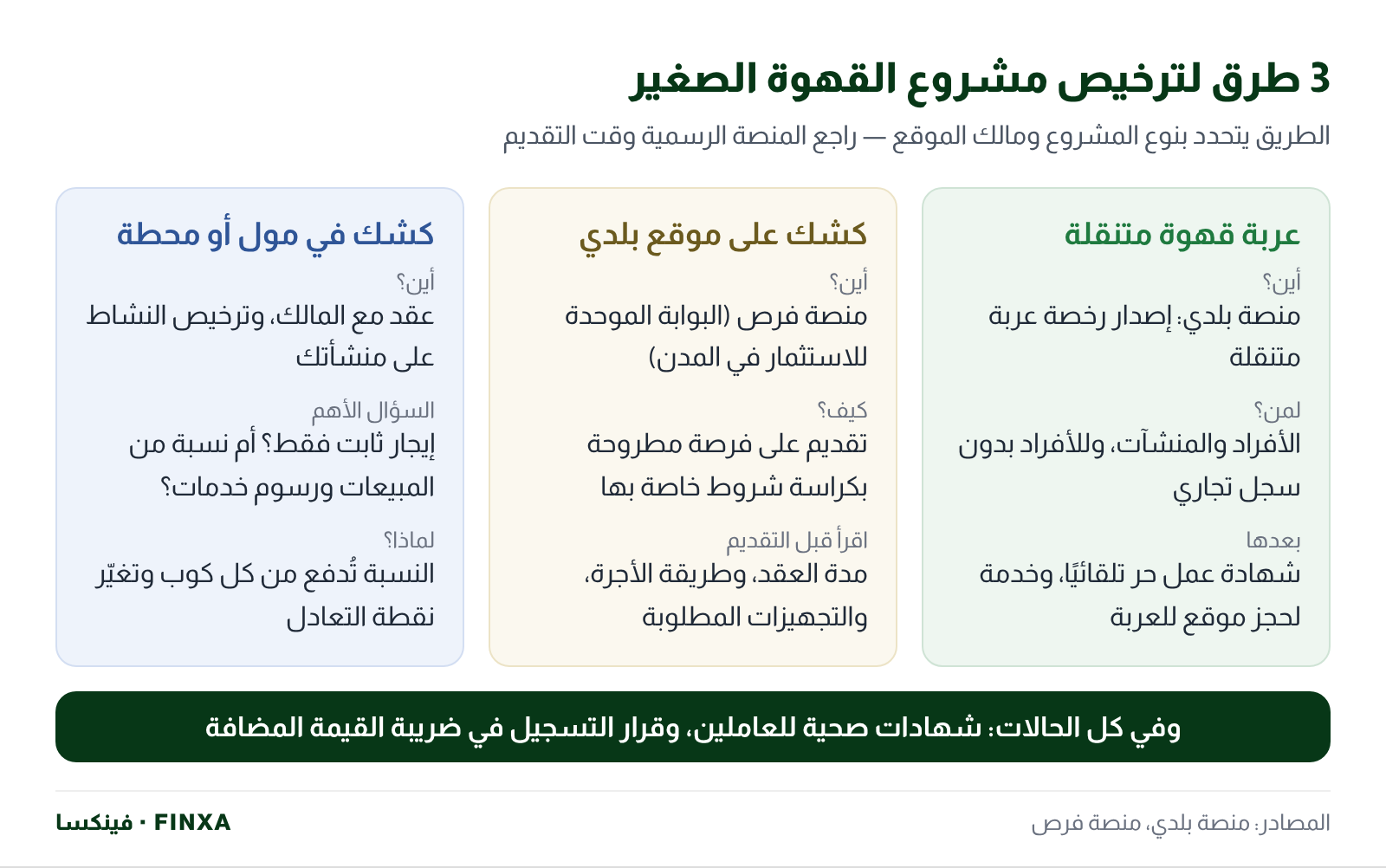
1) Mobile coffee cart: Licensed by Baladi platform
according to Mobile Vehicle License Issuance Service Page on the Baladi PlatformThe service is electronic and allows individuals to start their business. No need for a commercial registrationAfter the license is issued, a freelance work certificate is automatically generated. The stated processing time is 10 days, and fees are calculated using the platform's fee calculator. Within the same «Mobile Store Services» section, there is a service for reserving a location for the mobile vending license.
2) Kiosk on my municipality's website: the «Opportunities» platform»
Investment sites offered by municipalities and local authorities (including kiosk sites in parks, walkways, and roads) are displayed in Opportunities platformThe unified portal for investment in Saudi cities has its own terms and conditions booklet for each opportunity. Read the entire booklet before applying: contract duration, how the fee is calculated, and the equipment required of you.
3) Kiosk inside a mall or station: Contract with the owner
Here, the contract is with the mall or station management, and the license is for your establishment (commercial registration and business license as per the municipality). The most important question before signing: Is the rent a fixed amount only, or does it include a percentage of sales or service and marketing fees? This question alone changes the entire break-even point.
note: Whether it's a kiosk or a cart, food and beverage handlers need health certificates, and the general arrangement of financial procedures after licensing has been explained in [the following section/context]. Opening a restaurant in Saudi Arabia: 10 stepsIt is almost the same as the kiosk.
How much capital is needed for a coffee kiosk? (Explanatory example)
The following figures are an example of how to structure your thinking, not price quotes. Request two or three quotes for each item, and replace them with your own figures:
| Item | Fixed kiosk (riyal) | Coffee cart (Riyal) |
|---|---|---|
| Kiosk manufacturing and finishing / Cart purchase and outfitting | 40,000 | 45,000 |
| Espresso machine and grinder | 30,000 | 22,000 |
| Refrigerator, blender, ice maker and tools | 10,000 | |
| Cashier system and device | 3,000 | 3,000 |
| First month's stock (coffee, milk, and cups) | 5,000 | 4,000 |
| Licenses, insurance, and opening expenses | 7,000 | 3,000 |
| Working capital (two months' fixed expenses) | 36,000 | 16,000 |
| Total | 131,000 | 93,000 |
Pay attention to the working capital item: Most new kiosks do not reach the break-even point in the first month, and the money that covers rent and salaries during this period must be ready before the opening, not from today’s sales.
Cost of a cup of coffee in riyals
This is the most important figure in the entire project. Take your best-selling beverage (in our example, a 12-ounce latte priced at 16 riyals including tax) and calculate its cost based on your last supplier invoice:
| Item (illustrative example) | Calculation method | Real |
|---|---|---|
| Total selling price | From the menu | 16.00 |
| Value Added Tax | 16 × 15 ÷ 115 | −2.09 |
| Your net income | 13.91 | |
| Coffee beans (18 grams) | 0.018 x 90 riyals per kilo | 1.62 |
| Milk (220 ml) | 0.22 x 7 riyals per liter | 1.54 |
| Cup, lid and sleeve | From the supplier's invoice | 0.70 |
| Sugar, sticks and napkins | appreciation | 0.10 |
| 5% waste on coffee and milk | 5% × (1.62 + 1.54) | 0.16 |
| Cost of the cup | 4.12 | |
| Card payment fees (1% default) | 1% × 16 | 0.16 |
| You will have leftovers from each cup | 13.91 − 4.12 − 0.16 | 9.63 |
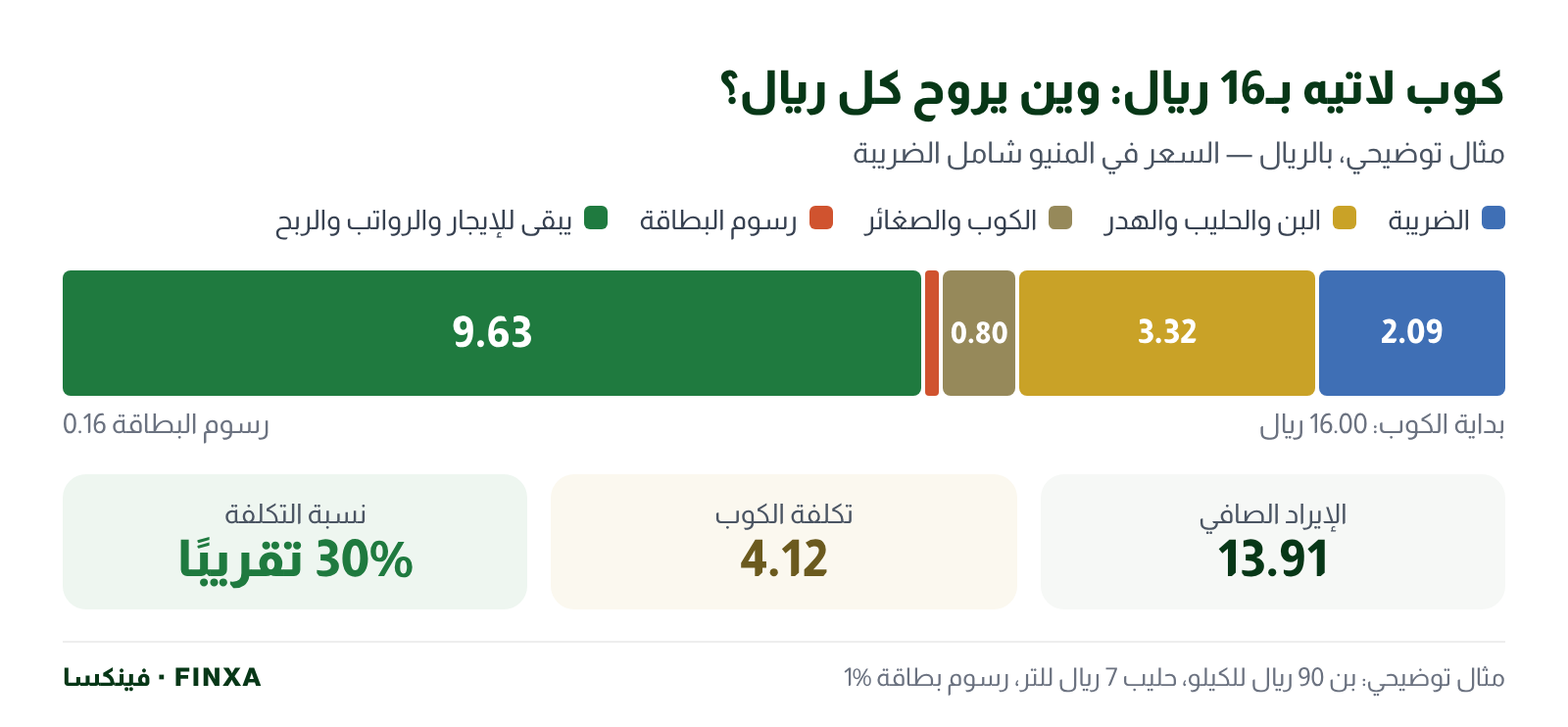
The cost of ingredients here represents approximately 30% of net revenue (4.12 ÷ 13.91). The figure that truly matters is 9.63 riyals: this covers rent and salaries, and what's left is your profit. Repeat this calculation for each beverage on the menu, as drip or Arabic coffee is generally less expensive, while cold drinks with added toppings are more. We explained the same method in detail for the dishes in [the relevant section]. The actual cost of the dish.
Break-even point: How many cups do you need to sell per day?
The fixed monthly expenses for the kiosk in our example are: rent 7,000, two employees at a total cost of 9,000 (salary, accommodation, insurance, and residency), electricity and water 500, cashier and internet 300, maintenance and cleaning 400, marketing 500, and miscellaneous 300. Total 18,000 riyals.
For the cart (the price of the cup is 14 riyals, leaving 7.91 riyals, and fixed expenses of 8,000 riyals): 8,000 ÷ 7.91 ÷ 30 = 33.7, meaning 34 cups a day.
Okay, what if I sell more or less? This is the kiosk's monthly profit before zakat at different levels:
| cups daily | Overall monthly sales | What remains of the cups | Monthly profit or loss |
|---|---|---|---|
| 50 | 24,000 | 14,445 | −3,555 |
| 63 (Die) | 30,240 | 18,201 | 201 |
| 80 | 38,400 | 23,112 | 5,112 |
| 100 | 48,000 | 28,890 | 10,890 |
| 120 | 57,600 | 34,668 | 16,668 |
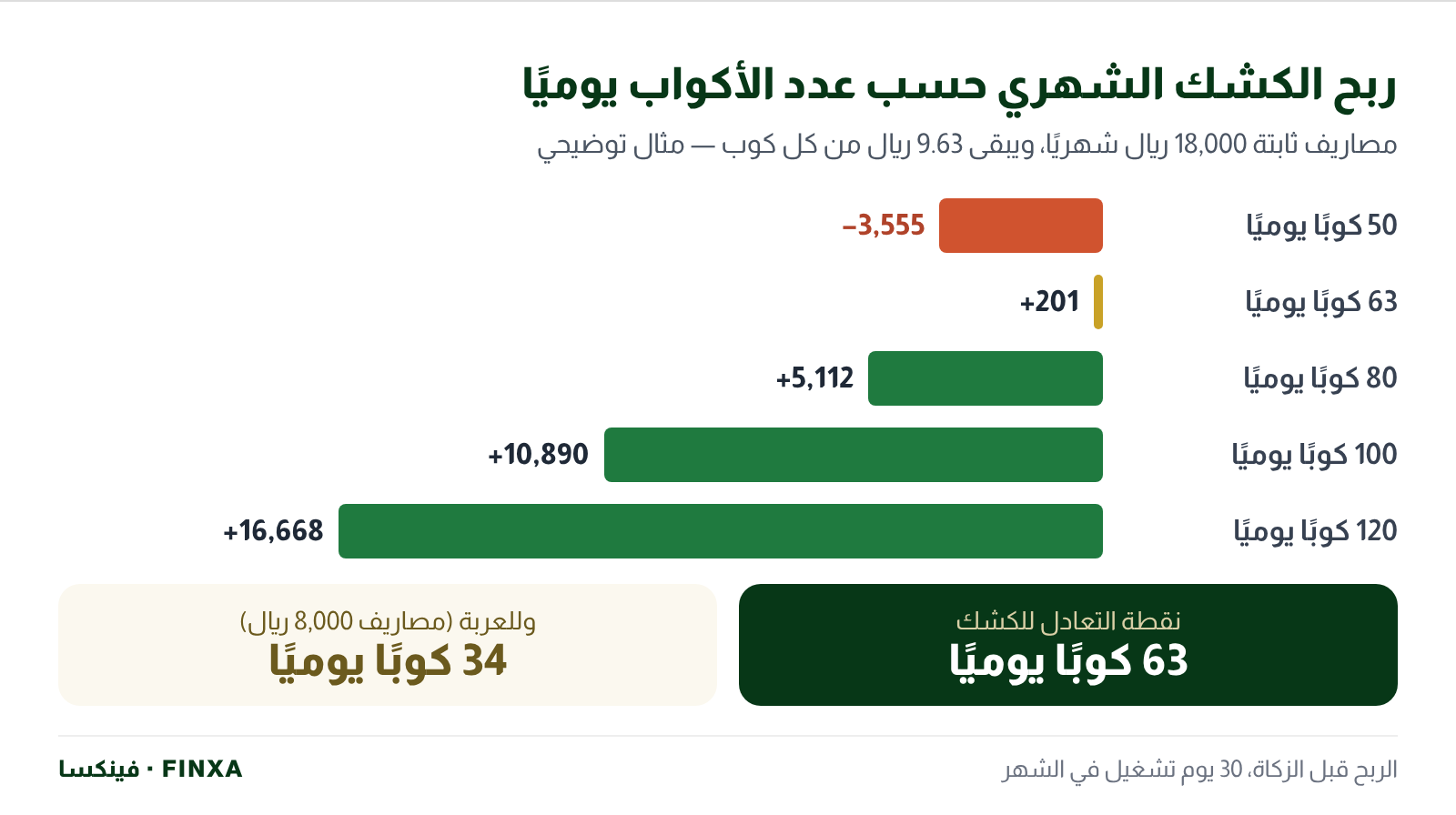
With 100 cups sold daily, the kiosk recovers its initial investment (131,000) in approximately 12 months (131,000 ÷ 10,890). With 50 cups sold daily, it incurs a loss of 3,555 riyals per month, meaning the working capital is depleted in about 10 months. The difference between success and failure here is 50 cups per day, which is why location is the most crucial decision in a kiosk project.
note: If the mall rent is a percentage of sales, add it to the variable cost per cup (e.g., 10% of net revenue = 1.39 riyals per cup) and recalculate the break-even point. The same kiosk might need 10 more cups per day.
Coffee kiosk and VAT
according to Individual VAT registration page at the Zakat, Tax and Customs AuthorityRegistration is mandatory for those whose annual revenue exceeds 375,000 riyalsMy choice is for those whose income exceeds 187,500 riyals and is less than 375,000 riyals, and the service is free of charge. This includes the owner of the vehicle who works as a self-employed individual with a freelance work certificate.
Note the paradox: the break-even point in our example is 63 cups, while the mandatory registration threshold is around 65 cups. This means that any kiosk that actually covers its costs is likely now required to register. Therefore, price your kiosk from the start inclusive of tax, choose a cashier who issues electronic invoices, and request tax invoices from your coffee, milk, and cup suppliers in your business's name. A cart selling 70 cups daily at 14 riyals would have annual sales of approximately 352,800 riyals: below the mandatory threshold and above the optional one.
If you register, set aside each month's tax payment in a separate account until your tax return is due and the funds are ready. If you'd like someone to file your tax return for you, we can help. VAT return preparation service.
Common mistakes in a coffee kiosk project
- Calculating the profit from the price of the cup: 16 riyals is not your profit. What remains in our example is 9.63 riyals, before rent and salaries.
- Signing the site contract before calculating the break-even point: Ask about the actual traffic on the site, and calculate: How many cups do I need per day to cover this rent?
- Ignore the sales percentage in the mall contract: It looks small, but it pays off with every cup, even in losing months.
- Without working capital: A kiosk that relies on daily sales to pay the monthly rent closes after the first weak month.
- Not locking the drawer daily: In a kiosk, there is usually only one employee who receives the cash, makes the sale, and closes the shop; the discrepancies are only revealed by...Daily cashier closure clear.
- Mix your kiosk account with your personal account: After that, you can't tell if the kiosk is even profitable.
Frequently Asked Questions
How much does it cost to open a coffee kiosk in Riyadh?
Prices vary depending on location and equipment. In our example, a fixed kiosk requires approximately 131,000 riyals, including two months' working capital, while a coffee cart costs around 93,000 riyals. Please include your actual price quotes in the same table.
Do I need a business registration for the coffee cart?
According to the Baladi platform, the mobile cart license service allows individuals to start operating without a commercial registration, after which they receive a freelance work certificate. As for a fixed kiosk in a mall or on an investment site, it is usually located within an existing facility and depends on the owner's terms or the opportunity's terms.
How many cups does the coffee stand sell daily to make a profit?
Calculate it for your project: Monthly fixed expenses ÷ What remains of the cup ÷ 30. In our example, 63 cups for the kiosk and 34 cups for the cart, and each cup above that is profit.
What percentage of the cost of a cup of coffee?
In the latte example, the ingredients and the cup account for approximately 30% of the net revenue after tax. The percentage varies depending on the beverage, the type of coffee, and the price of the milk, so calculate it for each item on the supplier's invoice.
Is a coffee kiosk subject to VAT?
Registration is mandatory if annual revenue exceeds 375,000 riyals, which equates to approximately 65 cups daily at 16 riyals each. Registration is optional for revenues between 187,500 and 375,000 riyals.
Coffee kiosk or coffee shop: which is better?
A kiosk requires less capital and has a closer break-even point, but its success depends on location and foot traffic. A café offers a seating and experience, and its costs are higher. Compare the figures in Feasibility study for a coffee shop in Riyadh.
Find out how much of each cup you have left each month.
At Finxa, we remotely handle the accounts of restaurants, cafes, and kiosks: daily closing, matching Mada, bank, and delivery apps, timely VAT filing, and a monthly report showing your actual profit and the cost of each drink.
- Free check of one month's books within 48 hoursWe will hand over to you every team we encounter.
- The first month of accounting is free, with no contract and no obligation. After that you choose: continue with us or stop and your notebooks are in order.
Contact us via the WhatsApp button on the website, or start here: